What Is Portfolio Rebalancing: A Quick Explainer

Portfolio rebalancing is the quiet hero of long-term investing — the process that keeps your portfolio aligned with your plan, regardless of how wild the markets get. Think of it as tending to a well-designed garden: trimming what’s overgrown, nurturing what needs more room, and keeping everything in harmony.
Why Rebalancing Is at the Heart of Your Strategy
Imagine your investment plan as a carefully mapped-out journey — your target asset allocation is the route, and your financial goals are the destination. Let’s say you begin with a 60/40 portfolio: 60% stocks for growth, 40% bonds for stability.
Over time, market movements shift that balance. A bull market pushes your stock holdings higher, turning your 60/40 mix into a 70/30 portfolio. Without any action, your risk profile has quietly changed — your ship is sailing faster, but through stormier waters.
This is portfolio drift, and it’s the hidden risk of passive neglect.
Rebalancing isn’t about chasing returns — it’s about controlling risk and staying true to your strategy.
By periodically selling portions of your best-performing assets and buying more of those that have lagged, you restore balance. This simple act — “selling high and buying low” — locks in gains, disciplines emotion, and keeps your portfolio aligned with your goals.
The True Purpose of Rebalancing Your Portfolio
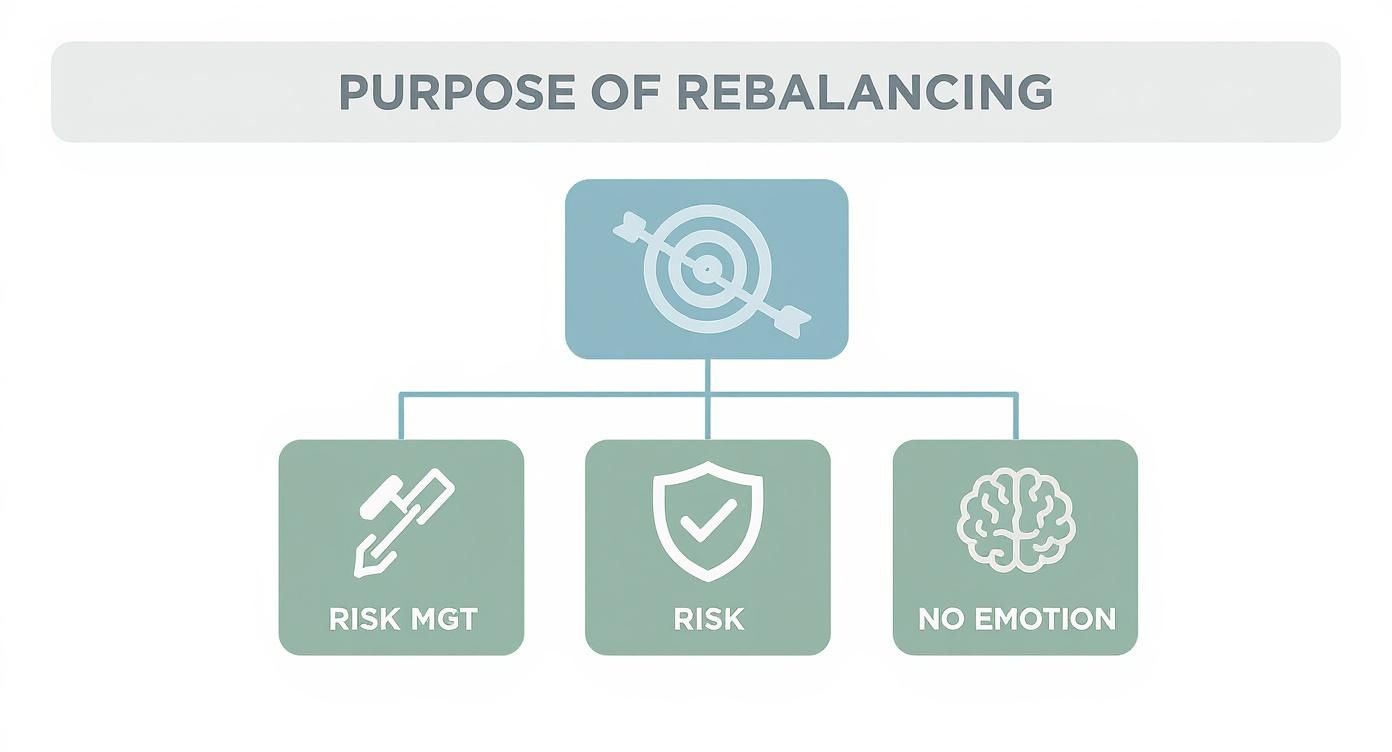
Rebalancing is often misunderstood as a performance booster. While it can sometimes improve returns, its true mission is risk control and emotional discipline.
Think of your portfolio as a ship designed for certain seas. Without rebalancing, strong markets can tilt that ship dangerously, overloading one side with risk. Rebalancing resets the balance — it’s the act of shifting weight to where it belongs, ensuring your ship stays steady no matter the weather.
Rebalancing isn’t about predicting the future; it’s about controlling your portfolio’s present.
This discipline also helps combat emotional investing. By automating the process on a set schedule or threshold, you lock in rational decision-making:
- Sell high — trim back what’s overgrown.
- Buy low — add to assets that have fallen behind.
It’s the perfect antidote to the “buy-high, sell-low” trap that catches so many investors.
For a deeper dive into how disciplined investing mitigates uncertainty, see our guide on risk management in an unpredictable world.
Common Portfolio Rebalancing Strategies
Different advisors use different methods to rebalance portfolios. There’s no one-size-fits-all approach — it depends on philosophy, client goals, and operational workflow.
1. Calendar-Based Rebalancing
The simplest approach. You rebalance on a fixed schedule — quarterly, semi-annually, or annually. ✅ Easy to implement ⚠️ May miss major market swings between review dates
2. Threshold-Based Rebalancing
Triggered only when an asset class drifts a set percentage (like 5%) from its target. ✅ Reacts to meaningful risk changes ⚠️ Requires more monitoring
3. Hybrid (Calendar + Threshold)
The “best of both worlds.” You review on a schedule but only act if drift crosses a threshold. ✅ Balanced and efficient ⚠️ Needs both review and monitoring
4. Tax-Aware Rebalancing
Adds a layer of tax efficiency, especially in taxable accounts. ✅ Minimizes capital gains ⚠️ More complex; requires planning
| Method | Trigger | Best For | Pros | Cons |
|---|---|---|---|---|
| Calendar-Based | Fixed time intervals | Simplicity and discipline | Easy to automate; consistent | May trade unnecessarily |
| Threshold-Based | Allocation drift | Responsive management | Cuts noise; targets real risk | Needs constant tracking |
| Hybrid | Both calendar and drift | Balanced approach | Disciplined yet flexible | Slightly more complex |
| Tax-Aware Overlay | Any of the above | Taxable accounts | Boosts after-tax returns | Planning required |
How to Rebalance Your Portfolio Step by Step
Step 1: Revisit Your Target Allocation
Confirm your ideal mix of stocks, bonds, and other assets — based on your goals and risk tolerance.
Step 2: Assess Current Allocations
Calculate where your portfolio stands today. Identify drift from the target.
Step 3: Calculate Adjustments
Figure out how much to sell from overweighted assets and how much to buy in underweighted ones.
Rebalancing is simply math applied to discipline.
Step 4: Choose What to Trade
Decide which securities to trim and which to add, keeping taxes and costs in mind.
Step 5: Execute and Monitor
Place trades, realign the portfolio, and set the stage for the next review cycle.
For example: A 60/40 portfolio worth $100,000 grows to $115,000 after a market rally — now it’s 65% stocks, 35% bonds. Sell $6,000 in stocks, buy $6,000 in bonds, and you’re back to 60/40 — perfectly balanced.
The Hidden Costs and Tax Implications
Every rebalance carries potential transaction fees and tax costs. Even in a low-commission world, capital gains taxes can erode returns.
Smart Strategies for Minimizing the Impact:
- Rebalance with new cash — use contributions or dividends instead of selling.
- Use tax-advantaged accounts first — IRAs and 401(k)s don’t trigger capital gains.
- Harvest losses strategically — offset gains with tax-loss harvesting.
For more on how to uncover hidden costs in portfolio management, see our piece on unlocking hidden profits with a cost analysis tool.
Automating Your Rebalancing Strategy
Manual rebalancing is time-consuming and prone to error. Automation changes the game.
Modern wealth management platforms monitor portfolios continuously, flagging or even executing trades automatically when drift thresholds are hit.
Automation turns rebalancing into a smart, rule-based system that enforces discipline without emotion.
Benefits of automated rebalancing:
- Consistency — applies the same logic to every portfolio.
- Efficiency — frees advisors from manual calculations.
- Emotional detachment — removes market bias from decisions.
- Tax optimization — integrates tax-aware logic into trade execution.
Automation isn’t just convenience — it’s fiduciary excellence at scale.
Got Questions? Let's Talk Rebalancing
How Often Should You Rebalance?
Start with annual reviews, or use a 5% threshold rule. The right frequency depends on portfolio size, strategy, and taxes.
Does Rebalancing Improve Returns?
Not always — but it consistently improves risk control. It’s about keeping the portfolio’s volatility aligned with the investor’s plan.
Can You Rebalance in a 401(k) or IRA?
Yes — and you should. Trades inside tax-advantaged accounts don’t trigger capital gains, making them perfect for regular rebalancing.
At PrizmaDesk, we help advisors automate rebalancing workflows across all client portfolios. Our platform ensures that every strategy stays disciplined, efficient, and aligned with its original intent.
Article created using Outrank
About PrizmaDesk
PrizmaDesk is a next-generation wealth analytics platform built for financial advisors and family offices. Automate reporting, manage portfolios with precision, and deliver a better client experience — all in one place.
Request a demo or connect with us to see how automation can streamline your rebalancing process.

Receive Insights on Wealth Technology
Stay informed with the latest wealth tech insights and industry best practices delivered directly to your email.